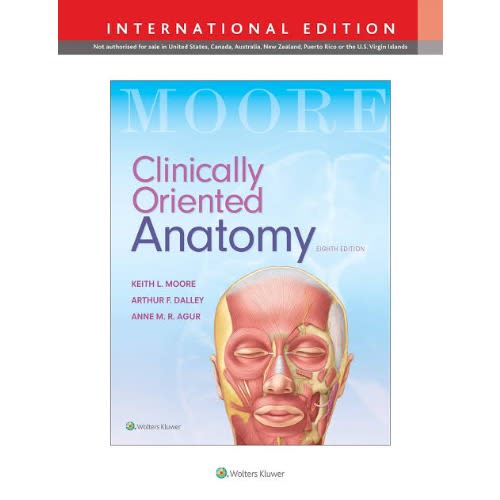
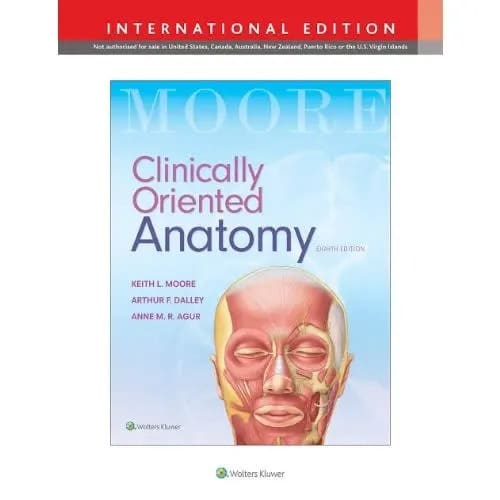
Renowned for its comprehensive coverage and engaging, storytelling approach, the bestselling Moore's Clinically Oriented Anatomy, 9th Edition, guides students from initial anatomy and foundational science courses through clinical training and practice. A popular resource for a variety of programs, this proven text serves as a complete reference, emphasizing anatomy that is important in physical diagnosis for primary care, interpretation of diagnostic imaging, and understanding the anatomical basis of emergency medicine and general surgery. The 9th Edition reflects the latest changes in the clinical application of anatomy as well as preparation for the USMLE while maintaining the highest standards for scientific and clinical accuracy.NEW! Sex and gender content clarifies important gender considerations and reflects an equitable focus on female as well as male anatomy.Updated medical imaging and integrated surface anatomy within each chapter clearly demonstrates the relationship between anatomy, physical examination, and diagnosis.Extensively revised Clinical Blue Boxes highlight the practical applications of anatomy, accompanied by helpful icons, illustrations, and images that distinguish the type of clinical information covered.Updated introduction establishes the foundational understanding of systemic information and basic concepts essential to success from the classroom to the dissection lab.Revised comprehensive surface anatomy photographs ensure accurate, effective physical examination diagnoses with integrated natural views of unobstructed surface anatomy and illustrations superimposing anatomical structures with landmarks for more accurate physical examination.Insightfully rendered, anatomically accurate illustrations, combined with many photographs and medical images, strengthen comprehension of anatomical concepts and retention of "mental images" of anatomical structures.Bottom Line boxes provide detailed summaries at a glance and underscore the "big-picture" perspective.Illustrated tables clarify complex information about muscles, veins, arteries, nerves, and other structures for easy study and review.Chapter outlines help students find key information quickly and efficiently.
Grant's Dissector, Sixteenth Edition, now revised to meet the needss of today's gross anatomy dissection courses, remains the go-to guide for dissection in the Anatomy lab. This Clssic mnual provides step-by-step dissection procedures with the instruction and anatomical detail you need to recognize important relationships revealed through Dissection. Each chapter is consistently organised beginning with a Dissection Overview, followed by detailed Dissection Instructions, and concluding with a Dissection follow -up.
The Dissection Overview provides a blueprint of what you will accomplish during the dissection session, and includes relevant surface anatomy as well as concise coverage of Osteology. Dissection Instructions offer a logical sequence and numbered steps for the dissection. the Dissection Follow-up emphasizes important features of the dissection and encourages you to reflect on and synthesize the information.
Davidson's Principles And Practice Of Medicine - 24th Edition
Well over two million medical students, doctors and other health professionals around the globe have owned a copy of Davidson’s Principles and Practice of Medicine since it was first published over 70 years ago. Now in its 24th Edition, this thoroughly updated textbook describes the pathophysiology and clinical features of the most frequently encountered conditions in the major specialties of adult medicine, and explains how to recognise, investigate, diagnose and manage them. Taking its origins from Sir Stanley Davidson’s much-admired lecture notes, Davidson’s has endured because it keeps pace with how modern medicine is taught and provides a wealth of trusted information in an easy-to-read, concise and beautifully illustrated format.
Key features:
Part 1 ‘Fundamentals of Medicine’ - provides an account of the principles of genetics, immunology, infectious diseases, population health, oncology and pain management, along with a discussion of the core principles behind clinical decision-making and good prescribing.
Part 2 ‘Emergency and Critical Care Medicine’ - covers medical emergencies in poisoning, envenomation and medicine in austere environments, as well as common presentations in acute medicine and the recognition and management of the critically ill.
Part 3 ‘Clinical Medicine’- covers the major medical specialties, each thoroughly revised and brought fully up to date. A new section on COVID-19 has been added and the impact of this infection is described throughout the book.
Clinical Examination overviews - extended and updated to summarise the main elements for each system.
Presenting Problems sections - provide a clear pathway for the assessment of and approach to the most common complaints in each specialty.
Practice Point summaries - detail the practical skills that medical students and junior doctors must acquire.
Emergency boxes - emphasise the core knowledge needed to manage acutely ill patients.
In Old Age, In Pregnancy and In Adolescence boxes - highlight differences in the practice of medicine in these patient groups, and illustrate the interfaces between medical, obstetric and paediatric services.
The text is extensively illustrated - with over 1000 diagrams, clinical photographs, and radiology and pathology images.
The global perspective is enhanced by an International Advisory Board of experts from 11 countries and by leading authors from around the world.
The complete, downloadable eBook version is included with your (print copy) purchase – for easy access on your portable device, anytime, anywhere! Now enhanced with:
NEW interactive self-assessment material –over 150Questions and Answers test your understanding of chapter key points and aid efficient exam preparation
Davidson’s will serve readers everywhere as a core text that integrates medical science with clinical medicine, conveying key knowledge and practical advice in a highly accessible and readable format.
The Developing Human Clinically Oriented Embryology 10th Edition
Extensively revised to incorporate recent research and current clinical practice, The Developing Human: Clinically Oriented Embryology, 11th Edition, covers all aspects of normal and abnormal embryonic and fetal development. In a clear, concise manner and lavishly illustrated throughout, this textbook is designed to successfully meet the needs of medical and health sciences profession students, as well as those in graduate programs. It provides an easy-to-digest, comprehensive review of what can be a complex and challenging subject. BONUS online features such as multiple-choice questions and narrated animations further support student success.
Guides readers month by month and stage by stage through embryo and fetal organ and systems development, using full-color photographs of clinical cases, relevant modern medical imaging, and numerous high-quality supportive figures.
Includes many new 3D HD color rendered images of embryos and fetuses, as well as 3D reconstructions of whole embryos.
Provides clinically-oriented problems for each chapter, with corresponding answers and explanations designed to facilitate discussion and learning. In addition, multiple-choice questions and answers are available online for supportive self-assessment.
Features 18 exceptional color animations, now with narration, to help students as they explore and learn the complexity of embryological development.
Provides the knowledge base needed for today's examinations, including USMLE Step 1, as well as for future clinical practice.
Thoroughly updated information includes new annotations on fundamental molecular events during embryogenesis, now required for many professional examinations.
Includes enhanced clinical material in all chapters, with updated tables, Clinical Case highlights and a critical chapter on common signalling pathways during development that covers gene editing (CRISPR/Cas9), induced pluripotent stem cells (iPS), a revision of the sonic hedgehog signalling pathway; and more.
Details how molecular biology has affected clinical practice, including techniques such as recumbent DNA technology and stem cell manipulation.Includes an Enhanced eBook
Now fully revised and updated, this leading ICT series volume offers concise, superbly illustrated coverage of neuroanatomy that throughout makes clear the relevance of the anatomy to the practice of modern clinical neurology. Building on the huge success of previous editions, Neuroanatomy ICT, fifth edition is designed and written primarily with the medical student in mind, although it will again be valued by the range of other students and professionals who need a clear, current understanding of this important area. Minimum assumptions are made of existing knowledge of the subject.
This edition now comes with an enhanced electronic version - hosted on the new, improved Student Consult platform ? providing an even richer learning experience and rapid reference anytime, anywhere!
"A clear guide to a complex subject that?s useful for students and clinicians alike not just for students: it?s also the perfect tool for refreshing the memory of a busy clinician" Reviewed by Dr Amit Kumar,GP in Aylesford, On behalf of (journal):Pulse
Notoriously difficult concepts made clear in straightforward and concise textLevel of detail carefully judged to facilitate understanding of the fundamental neuroanatomical principles and the workings of the nervous system, providing a sound basis for the diagnosis and treatment of contemporary neurological disordersAll new line drawings and photographs incorporated throughout to further improve clarity and reflect the latest imaging techniquesClinical material and topic summaries fully updated and highlighted in succinct boxes within the textClinical syndromes/symptoms index provided with cross-referencing to relevant textMemorable pictorial summaries of symptoms associated with the main clinical syndromesNew added value electronic content & ndash; including self-assessment material to aid revision and check your understanding & ndash; is incorporated within the superb, complimentary enhanced eBookNew description of transmitters in the brain stem.Increased coverage of the peripheral nerves.Clinical material updated to reflect current prevalence of neurological disease.Large proportion of artwork redrawn to incorpaorate slightly more detail.Anatomical mechanism of new therapies (such as stem cells) mentioned.Publisher & rlm; : & lrm; Churchill Livingstone; 5th edition (20 May 2014)Language & rlm; : & lrm; EnglishPaperback & rlm; : & lrm; 208 pagesISBN-10 & rlm; : & lrm; 0702054054ISBN-13 & rlm; : & lrm; 978-0702054051Dimensions & rlm; : & lrm; 20.96 x 1.27 x 29.85 cm
EMDEX Drug Information for Healthcare Professionals) |Completely revised and updated with over 10000 registered pharmaceuticals and allied products. First published in 1991 as Nigeria's Essential Drug Guide (NED Guide), EMDEX has remained Nigeria's trusted source of drug and therapeutic information to date. EMDEX is the acronym for Essential Medicines InDEX. Based on both WHO Model Formulary and Nigeria's Essential Drug List, EMDEX is unique to Nigeria as it also details mainly the drug products approved for use in Nigeria.
Unique Features of EMDEX
& bull; Pharmacovigilance & ndash; important Drug Safety Communication from US FDA, Health Canada, UK MHRA, EMA, WHO DI, etc.
& bull; Exhaustive Drug Information
& bull; Concise Therapeutic Notes
& bull; Comprehensive Pharmacologic-Therapeutic Classifications based on WHO ATC and AHFS PTC
& bull; Indications Index & ndash; Lists the Diseases covered in Nigeria & rsquo;s Standard Treatment Guideline (NSTG, 2016 ed.) and the Drugs Recommended for their Treatment.
& bull; Drug Interactions & bull; Drug Use in Special Populations including Pregnancy & Lactation, Renal & Hepatic Impairment
. & bull; Guide to Drug Administration & ndash; Essential Guide especially for Nurse Practitioners.
& bull; Natural Health Products including Herbals, Multivitamins & Minerals.
& bull; Detailed Drug Product Information including their NAFDAC Registration Numbers, Product Description, etc.
Now fully revised and updated, this leading ICT series volume offers concise, superbly illustrated coverage of neuroanatomy that throughout makes clear the relevance of the anatomy to the practice of modern clinical neurology. Building on the huge success of previous editions, Neuroanatomy ICT, fifth edition is designed and written primarily with the medical student in mind, although it will again be valued by the range of other students and professionals who need a clear, current understanding of this important area. Minimum assumptions are made of existing knowledge of the subject.
This edition now comes with an enhanced electronic version - hosted on the new, improved Student Consult platform ? providing an even richer learning experience and rapid reference anytime, anywhere!
"A clear guide to a complex subject that?s useful for students and clinicians alike not just for students: it?s also the perfect tool for refreshing the memory of a busy clinician" Reviewed by Dr Amit Kumar,GP in Aylesford, On behalf of (journal):Pulse
Notoriously difficult concepts made clear in straightforward and concise textLevel of detail carefully judged to facilitate understanding of the fundamental neuroanatomical principles and the workings of the nervous system, providing a sound basis for the diagnosis and treatment of contemporary neurological disordersAll new line drawings and photographs incorporated throughout to further improve clarity and reflect the latest imaging techniquesClinical material and topic summaries fully updated and highlighted in succinct boxes within the textClinical syndromes/symptoms index provided with cross-referencing to relevant textMemorable pictorial summaries of symptoms associated with the main clinical syndromesNew added value electronic content & ndash; including self-assessment material to aid revision and check your understanding & ndash; is incorporated within the superb, complimentary enhanced eBookNew description of transmitters in the brain stem.Increased coverage of the peripheral nerves.Clinical material updated to reflect current prevalence of neurological disease.Large proportion of artwork redrawn to incorpaorate slightly more detail.Anatomical mechanism of new therapies (such as stem cells) mentioned.Publisher & rlm; : & lrm; Churchill Livingstone; 5th edition (20 May 2014)Language & rlm; : & lrm; EnglishPaperback & rlm; : & lrm; 208 pagesISBN-10 & rlm; : & lrm; 0702054054ISBN-13 & rlm; : & lrm; 978-0702054051Dimensions & rlm; : & lrm; 20.96 x 1.27 x 29.85 cm
Now fully revised and updated, this leading ICT series volume offers concise, superbly illustrated coverage of neuroanatomy that throughout makes clear the relevance of the anatomy to the practice of modern clinical neurology. Building on the huge success of previous editions, Neuroanatomy ICT, fifth edition is designed and written primarily with the medical student in mind, although it will again be valued by the range of other students and professionals who need a clear, current understanding of this important area. Minimum assumptions are made of existing knowledge of the subject.
This edition now comes with an enhanced electronic version - hosted on the new, improved Student Consult platform ? providing an even richer learning experience and rapid reference anytime, anywhere!
"A clear guide to a complex subject that?s useful for students and clinicians alike not just for students: it?s also the perfect tool for refreshing the memory of a busy clinician" Reviewed by Dr Amit Kumar,GP in Aylesford, On behalf of (journal):Pulse
Notoriously difficult concepts made clear in straightforward and concise textLevel of detail carefully judged to facilitate understanding of the fundamental neuroanatomical principles and the workings of the nervous system, providing a sound basis for the diagnosis and treatment of contemporary neurological disordersAll new line drawings and photographs incorporated throughout to further improve clarity and reflect the latest imaging techniquesClinical material and topic summaries fully updated and highlighted in succinct boxes within the textClinical syndromes/symptoms index provided with cross-referencing to relevant textMemorable pictorial summaries of symptoms associated with the main clinical syndromesNew added value electronic content & ndash; including self-assessment material to aid revision and check your understanding & ndash; is incorporated within the superb, complimentary enhanced eBookNew description of transmitters in the brain stem.Increased coverage of the peripheral nerves.Clinical material updated to reflect current prevalence of neurological disease.Large proportion of artwork redrawn to incorpaorate slightly more detail.Anatomical mechanism of new therapies (such as stem cells) mentioned.Publisher & rlm; : & lrm; Churchill Livingstone; 5th edition (20 May 2014)Language & rlm; : & lrm; EnglishPaperback & rlm; : & lrm; 208 pagesISBN-10 & rlm; : & lrm; 0702054054ISBN-13 & rlm; : & lrm; 978-0702054051Dimensions & rlm; : & lrm; 20.96 x 1.27 x 29.85 cm
Pathology Illustrated 7th Edition By Robin Reid / Fiona Roberts
Generations of medical and other health science students have been helped to pass their exams by the acclaimed "Illustrated" books. The clear, visual presentation of the subject matter, divided into one-page units, makes for easy learning and recall.
Pathology remains central to the study of medicine and forms the bridge between the basic sciences and clinical medicine. "Pathology Illustrated" covers all the essential information in as clear and concise a way as possible, focusing on what is most clinically important.
Features:
- Covers both basic and systematic pathology.
- Visual presentation for easy learning and re-call.
Davidson's Principles And Practice Of Medicine 24th Edition
Well over two million medical students, doctors and other health professionals around the globe have owned a copy of Davidson’s Principles and Practice of Medicine since it was first published over 70 years ago. Now in its 24th Edition, this thoroughly updated textbook describes the pathophysiology and clinical features of the most frequently encountered conditions in the major specialties of adult medicine, and explains how to recognise, investigate, diagnose and manage them. Taking its origins from Sir Stanley Davidson’s much-admired lecture notes, Davidson’s has endured because it keeps pace with how modern medicine is taught and provides a wealth of trusted information in an easy-to-read, concise and beautifully illustrated format.
Key features:
Part 1 ‘Fundamentals of Medicine’ - provides an account of the principles of genetics, immunology, infectious diseases, population health, oncology and pain management, along with a discussion of the core principles behind clinical decision-making and good prescribing.
Part 2 ‘Emergency and Critical Care Medicine’ - covers medical emergencies in poisoning, envenomation and medicine in austere environments, as well as common presentations in acute medicine and the recognition and management of the critically ill.
Part 3 ‘Clinical Medicine’- covers the major medical specialties, each thoroughly revised and brought fully up to date. A new section on COVID-19 has been added and the impact of this infection is described throughout the book.
Clinical Examination overviews - extended and updated to summarise the main elements for each system.
Presenting Problems sections - provide a clear pathway for the assessment of and approach to the most common complaints in each specialty.
Practice Point summaries - detail the practical skills that medical students and junior doctors must acquire.
Emergency boxes - emphasise the core knowledge needed to manage acutely ill patients.
In Old Age, In Pregnancy and In Adolescence boxes - highlight differences in the practice of medicine in these patient groups, and illustrate the interfaces between medical, obstetric and paediatric services.
The text is extensively illustrated - with over 1000 diagrams, clinical photographs, and radiology and pathology images.
The global perspective is enhanced by an International Advisory Board of experts from 11 countries and by leading authors from around the world.
The complete, downloadable eBook version is included with your (print copy) purchase – for easy access on your portable device, anytime, anywhere! Now enhanced with:
NEW interactive self-assessment material –over 150Questions and Answers test your understanding of chapter key points and aid efficient exam preparation
Davidson’s will serve readers everywhere as a core text that integrates medical science with clinical medicine, conveying key knowledge and practical advice in a highly accessible and readable format
Part of the highly regarded Nelson family of pediatric references, Nelson Essentials of Pediatrics, 8th Edition, is a concise, focused resource for medical students, pediatric residents, PAs, and nurse practitioners. Ideal for pediatric residencies, clerkships, and exams, this 8th Edition offers a readable, full-color format; high-yield, targeted chapters; and new features that make it even more user-friendly for today & rsquo;s in-training professionals or practitioners.
Focuses on the core knowledge you need to know, while also providing complete coverage of recent advances in pediatrics. Coverage includes normal childhood growth and development, as well as the diagnosis, management, and prevention of common pediatric diseases and disorders.
Includes new Pearls for Practitioners bullets at the end of each section, providing key clinical points and treatment information.
Features well written, high-yield coverage throughout, following COMSEP curriculum guidelines relevant to your pediatric clerkship or rotation.
Uses a full-color format with images and numerous new tables throughout, so you can easily visualize complex information.
Provides real-world insights from chapter authors who are also Clerkship Directors, helping you gain the knowledge and skills necessary to succeed both in caring for patients and in preparing for clerkship or in-service examinations.
Includes Student Consult access which features the full contents of the book, now integrated with select decision-making algorithms from Pediatric Decision-Making Strategies by Pomeranz et al. (ISBN: 978-0-323-29854-4), online at Student Consult
Harpers Illustrated Biochemistry 31st Edition By Victor Rodwell - David Bender - Kathleen M
Gain a thorough understanding of the principles of biochemistry as they relate to the study of clinical medicine.The 31st Edition of Harper & rsquo;s Illustrated Biochemistry combines outstanding full-color illustrations with authoritative integrated coverage of biochemical disease and clinical information. Using brevity and numerous medically relevant examples, Harper's presents a clear, succinct review of the fundamentals of biochemistry that every student must understand in order to succeed in medical school.Features:- All chapters emphasize the medical relevance of biochemistry.- Full-color presentation includes more than 600 illustrations.- Each chapter includes a section on Biomedical Importance and a summary of the topics covered.- Review questions follow each of the eleven sections.- Case studies in every chapter emphasize the clinical relevance to biochemistry.- New coverage of toxic naturally-occurring amino acids; extraterrestrial biomolecules; computer-aided drug design; the role of complement cascade in bacterial and viral infection; secreted mediators of cell-cell signaling between leukocytes; the role of mast cells, basophils, and eosinophils; and the hazard of antioxidants that down-regulate radical signaling for apoptosis and increase risk of cancer.Applauded by medical students for its current and engaging style, Harper's Illustrated Biochemistry is an essential for USMLE review and the single best reference for learning the clinical relevance of any biochemistry topic.About the Authors:- David A. Bender, PhD, (London, England) Sub-Dean, University College Medical School, Senior Lecturer in Biochemistry, Department of Structural and Molecular Biology and Division of Medical Education, University College London.- Kathleen M. Botham, PhD, DSc (London, England), Professor of Biochemistry, Royal Veterinary College, University of London.- Peter J. Kennelly, PhD (Blacksburg, VA), Professor and Head, Department of Biochemistry, Virginia Polytechnic Institute and State University.- Victor W. Rodwell, PhD (West Lafayette, IN), Emeritus Professor of Biochemistry, Purdue University.- P. Anthony Weil, PhD (Nashville, TN), Professor of Molecular Physiology and Biophysics, Vanderbilt University School of Medicine.