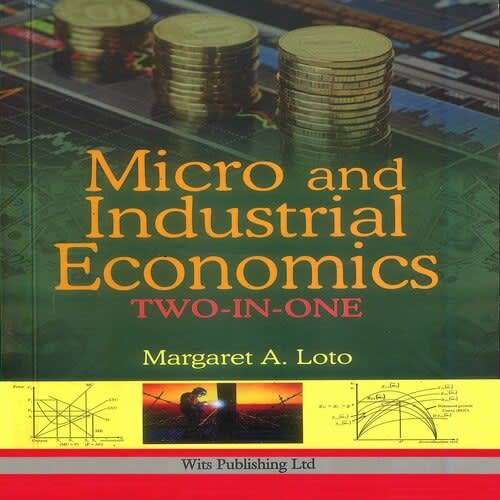
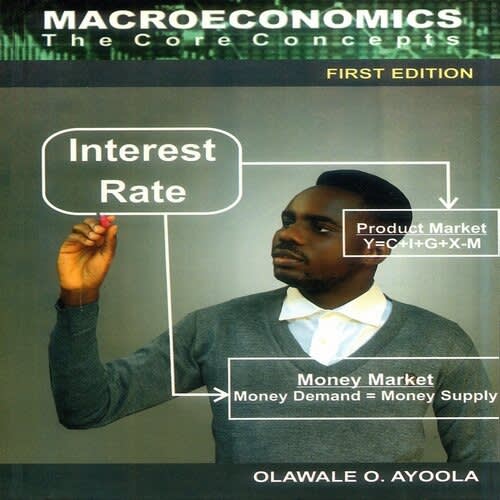
THIS book, Macroeconomics and Its Tools of Analysis, is tailored towards the need of undergraduate and postgraduate levels of studies. Presented in twenty chapters, it is a very detailed piece of work on the relevant concepts and tools of analysis in dealing with microeconomics. It is an ideal text for students at undergraduate and postgraduate levels in economics, business administration, finance, accounting, as well as those undergoing professional studies.
The approach is as simple as the relevant concepts that are effectively covered. The chapters are arranged to ensure flow of ideas and thoughts as they adequately cover contemporary issues and fundamental principles of macro- economics. At the end of chapter eighteen, there are worked examples and also unsolved problems. In chapters 19 and 20 mathematical concepts are copiously explained with several examples and spiced with exercises for student's practice. Over 370 objective questions and answers are provided for students to test their understanding of the subject.
Students and lectures will find the work invaluable as an adequate recommended class text.
Transport Phenomena - Revised 2nd Edition Hardback
The market leading transport phenomena text has been revised! Authors, Bird, Stewart and Lightfoot have revised Transport Phenomena to include deeper and more extensive coverage of heat transfer, enlarged discussion of dimensional analysis, a new chapter on flow of polymers, systematic discussions of convective momentum, energy, and mass transport, and transport in two-phase systems.
If this is your first look at Transport Phenomena you'll quickly learn that its balanced introduction to the subject of transport phenomena is the foundation of its long-standing success.
About the Revised 2nd Edition: Since the appearance of the second edition in 2002, the authors and numerous readers have found a number of errors--some major and some minor. In the Revised 2ndEdition the authors have endeavored to correct these errors. A new ISBN has been assigned to the Revised 2nd Edition in order to more easily identify the most correct version.
\
The market leading transport phenomena text has been revised! Authors, Bird, Stewart and Lightfoot have revised Transport Phenomena to include deeper and more extensive coverage of heat transfer,
enlarged discussion of dimensional analysis, a new chapter on flow of polymers, systematic discussions of convective momentum, energy, and mass transport, and transport in two-phase systems.
If this is your first look at Transport Phenomena you'll quickly learn that its balanced introduction to
the subject of transport phenomena is the foundation of its long-standing success.
The market leading transport phenomena text has been revised! Authors, Bird, Stewart and Lightfoot have revised Transport Phenomena to include deeper and more extensive coverage of heat transfer, enlarged discussion of dimensional analysis, a new chapter on flow of polymers, systematic discussions of convective momentum, energy, and mass transport, and transport in two-phase systems.
If this is your first look at Transport Phenomena you'll quickly learn that its balanced introduction to the subject of transport phenomena is the foundation of its long-standing success.
About the Revised 2nd Edition: Since the appearance of the second edition in 2002, the authors and numerous readers have found a number of errors--some major and some minor. In the Revised 2ndEdition the authors have endeavored to correct these errors. A new ISBN has been assigned to the Revised 2nd Edition in order to more easily identify the most correct version.
A history of how corporate innovation has shaped society, from ancient Rome to Silicon Valley From legacy manufacturers to emerging tech giants, corporations wield significant power over our lives, our economy, and our politics. Some celebrate them as engines of progress and prosperity. Others argue that they recklessly pursue profit at the expense of us all. In For Profit, law professor William Magnuson reveals that both visions contain an element of truth.
The story of the corporation is a human story, about a diverse group of merchants, bankers, and investors that have over time come to shape the landscape of our modern economy.
Its central characters include both the brave, powerful, and ingenious and the conniving, fraudulent, and vicious. At times, these characters have been one and the same. Yet as Magnuson shows, while corporations haven & rsquo;t always behaved admirably, their purpose is a noble one.
From their beginnings in the Roman Republic, corporations have been designed to promote the common good. By recapturing this spirit of civic virtue,
For Profit argues, corporations can help craft a society in which all of us & mdash;not just shareholders & mdash;benefit from the profits of the enterprise
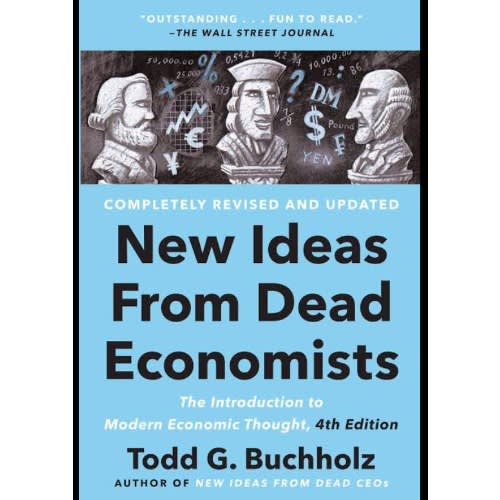
New Ideas From Dead Economists - An Introduction To Modern Economic Thought
"If you read only one economics book this year, read this one. & rdquo; & mdash;Larry Summers, Secretary of the Treasury for President Clinton, Director of the National Economic Council for President ObamaA must-read for students of economics, New Ideas from Dead Economists offers an entertaining and accessible introduction to the great economic thingers throughout history.Through the teachings of Adam Smith, John Stuart Mill, Karl Marx, John Maynard Keynes, and more, renowned economist Todd Buchholz shows how these age-old ideas still apply to our modern world. In this revised edition, Buchholz offers an insightful and informed perspective on key economic issues in the new millennium: increasing demand for energy, the rise of China, international trade, aging populations, health care, and the effects of global warming. New Ideas from Dead Economists is a fascinating guide to understanding both the evolution of economic theory and our complex contemporary economy.
The Coming Economic Collapse: How You Can Thrive When Oil Costs $200 A Barrel
In this incredibly timely book,renowned economist Stephen Leeb shows how surging oilprices will contribute to a huge economic collapse bysoaring to over $100, and perhaps $200, a barrel- andtells how you can avoid the pitfalls of the upcoming crisis.
Vulture Capitalism: Corporate Crimes Backdoor Bailouts And The Death Of Freedom
Longlisted for the 2024 Women & rsquo;s Prize for NonfictionA Next Big Idea Book Club Must-Read for March 2024In the vein of The Shock Doctrine and Evil Geniuses, this timely manifesto from an acclaimed journalist illustrates how corporate and political power brokers have used planned capitalism to advance their own interests at the expense of the rest of us & mdash;and how we can take back our economy for all.It & rsquo;s easy to look at the state of the world around us and feel hopeless. We live in an era marked by war, climate crisis, political polarization, and acute inequality & mdash;and yet many of us feel powerless to do anything about these profound issues. We & rsquo;ve been assured that unfettered capitalism is necessary to ensure our freedom and prosperity, even as we see its corrosive effects proliferating daily. Why, in our age of unchecked corporate power, are most of us living paycheck to paycheck? When the economy falters, why do governments bail out corporations and shareholders but leave everyday people in the dust?Now, economic and political journalist and progressive star on the rise Grace Blakeley exposes the corrupt system that is failing all around us, pulling back the curtain on the free market mythology we have been sold, and showing how, as corporate interests have taken hold, governments have historically been shifting away from competition and democracy and towards monopoly and oligarchy.Tracing over a century of neoliberal planning and backdoor bailouts, Blakeley takes us on a deeply reported tour of the corporate crimes, political maneuvering, and economic manipulation that elites have used to enshrine a global system of & ldquo;vulture capitalism & rdquo; & mdash;planned capitalist economies that benefit corporations and the uber-wealthy at the expense of the rest of us & mdash;at every level, from states to empires. Blakeley exposes the cracks already emerging within capitalism, lighting a path forward for how we can democratize our economy, not just our politics, to ensure true freedom for all.
To be a good economic analyst and all-round student of Macroeconomics, an in-depth knowledge of core Macroeconomics concepts is fundamental. This is because, the subject entails a critical assessment of how Macroeconomics variables such as inflation, interest rate, exchange rate, unemployment rate, investment and output growth rate respond to government policies. Not only that, it also effective participation in issues relating to aggregate economic performance.
For the policy makers, the beauty of any policy lies in its ability to adequately address fundamental economic problem This however requires professional knowledge of the nature of the relationship among key Macroeconomics variables. This text book provides a platform to assess those relationships and how they respond to government policies.
For the students taking Macroeconomics at the undergraduate graduate and the professional level, this text book provides explicit explanations to Macroeconomic theories using graphs algebra and mathematical equations. These were deemed necessary considering the complexicity of Macroeconomics examinations. All graphs, mathematical equations and algebra were provided in a simplified manner to demystify the subject.
Theory Of Econometrics By A. Koutsoyiannis - Second Edition
'A textbook which emphasises clarity of exposition and simplification of the mathematical presentation of topics. Assumes only college algebra and introductory statistics, since the greatest attention is given to the economic aspects of econometrics'. Journal of Economic Literature.'A textbook which emphasises clarity of exposition and simplification of the mathematical presentation of topics. Assumes only college algebra and introductory statistics, since the greatest attention is given to the economic aspects of econometrics
This second edition of Theory of Econometrics is a book that provides the readers with key insights into the fundamentals of econometrics and its applications. Econometrics is the process of applying statistical methods, computer science, and mathematics, to economic data, so that these data can be used in making important government or business decisions.
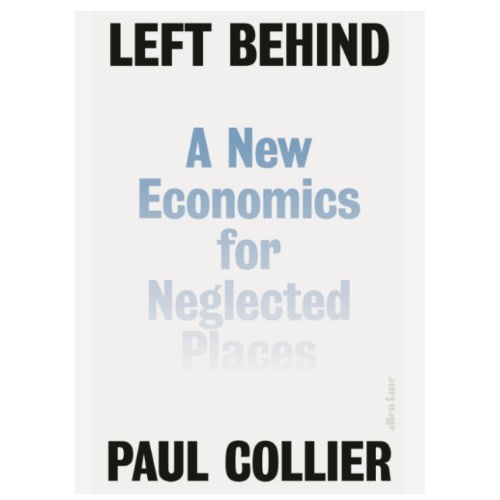
Left Behind - A New Economics For Neglected Places
The bestselling author of The Bottom Billion returns to examine the fate of the poorest regions of the world, some of which exist in the richest nationsSince the 1970s, the Western consensus in economic policy has been governed by the assumption that any poor area & mdash;a city, a state or even an entire country & mdash;will find a way to progress through market forces. If local economies fail to revive, and market shifts have made a location unsuited to business needs, the workforce can and should relocate to more prosperous locales. Either way, no outside intervention is necessary: one way or another, the problem will work itself out. Except it doesn & rsquo;t. Using examples of the & ldquo;left behind & rdquo; regions, renowned development economist Paul Collier shows that centralized western economies have been the most ineffective to alleviate poverty & mdash;even if nationally the country seems to be growing. South Yorkshire, once a hub of the steel industry, is now the poorest region in England. From the United States to Japan, Zambia to Colombia, regions and nations experiencing economic decline find themselves with little recourse, ignored by the powers that could come to their aid. In Left Behind, Collier examines how this one-size-fits-all, hands-off approach to economic policy has devastated areas and nations all over the world and made society vastly more unequal. With keen insight, he draws lessons from such disparate fields as behavioral psychology, evolutionary biology, and moral philosophy to explain how we can adapt to the needs of individual economies in order to build a brighter and fairer global future.
Creative Capitalism: A Conversation With Bill Gates- Warren Buffett And Other Economic Leaders
Bill Gates is more than the world's most successful capitalist; he's also the world's biggest philanthropist.Gates has approached philanthropy the same way he revolutionized computer software: with a fierce ambition to change the rules of the game. That's why at the 2008 annual meeting of the World Economic Forum in Davos, Switzerland, Gates advocated a creative capitalism in which big corporations, the distinguishing feature of the modern global economy, integrate doing good into their way of doing business.This controversial new idea is discussed and debated by the more than forty contributors to this book, among them three Nobel laureates and two former U.S. cabinet secretaries. Edited by author and columnist Michael Kinsley, Creative Capitalism started as a first-of-its-kind online conversation that brought together some of the world's best minds to engage Gates's challenge. From Warren Buffett, who seconds Gates's analysis, to Lawrence Summers, who worries about the consequences of multiple corporate objectives, the essays cover a broad spectrum of opinion. Judge Richard Posner dismisses Gates's proposal as trumped-up charity that will sap the strengths of the profit-maximizing corporation, while journalist Martin Wolf maintains that the maximization of profit is far from universally accepted, and rightly so. Chicago Nobel laureate Gary Becker wonders whether altruistic companies can survive in a competitive economy, while Columbia Nobel laureate Edmund Phelps argues that a little altruism might be the right prescription for a variety of market imperfections.Creative Capitalism is not just a book for philanthropists. It's a book that challenges the conventional wisdom about our economic system, a road map for the new global economy that is emerging as capitalism adapts itself once again to a changing world.
Megathreats: Ten Dangerous Trends That Imperil Our Future, And How To Survive Them
"Read and pay attention" (Martin Wolf, the Financial Times): the bestselling author of Crisis Economics argues we are heading toward the worst economic catastrophe of our lifetimes, unless we can defend against ten terrifying threats.Renowned economist Nouriel Roubini was nicknamed & ldquo;Dr. Doom, & rdquo; until his prediction of the 2008 housing crisis and Great Recession came true--when it was too late. Now he is back with a much scarier prediction, one that we ignore at our peril. There are no fewer than ten overlapping, interconnected threats that are so serious, he calls them Megathreats. From the worst debt crisis the world has ever seen, to governments pumping out too much money, to borders that are blocked to workers and to many shipments of goods, to the rise of a new superpower competition between China and the U.S., to climate change that strikes directly at our most populated cities, we are facing not one, not two, but ten causes of disaster. There is a slight chance we can avoid them, if we come to our senses & mdash;but we must act now. In the 1970s, the U.S. faced stagflation: high rates of inflation combined with stagnant employment and growth. Today, we are heading toward a Great Stagflation that will make the 1970s look like a walk in the park.